
Overview: Understanding the types of vacuum cleaners to help you choose the right one.
The household vacuum cleaner market has become increasingly diverse in terms of design, technology, and usage methods. Understanding the main types of vacuum cleaners helps users make informed decisions and provides a solid foundation for technical comparison and evaluation.
Below are four common ways to classify household vacuum cleaners, based on structure, usage, and filtration technology.
1. Canister Vacuum Cleaners
Key Characteristics and Technologies
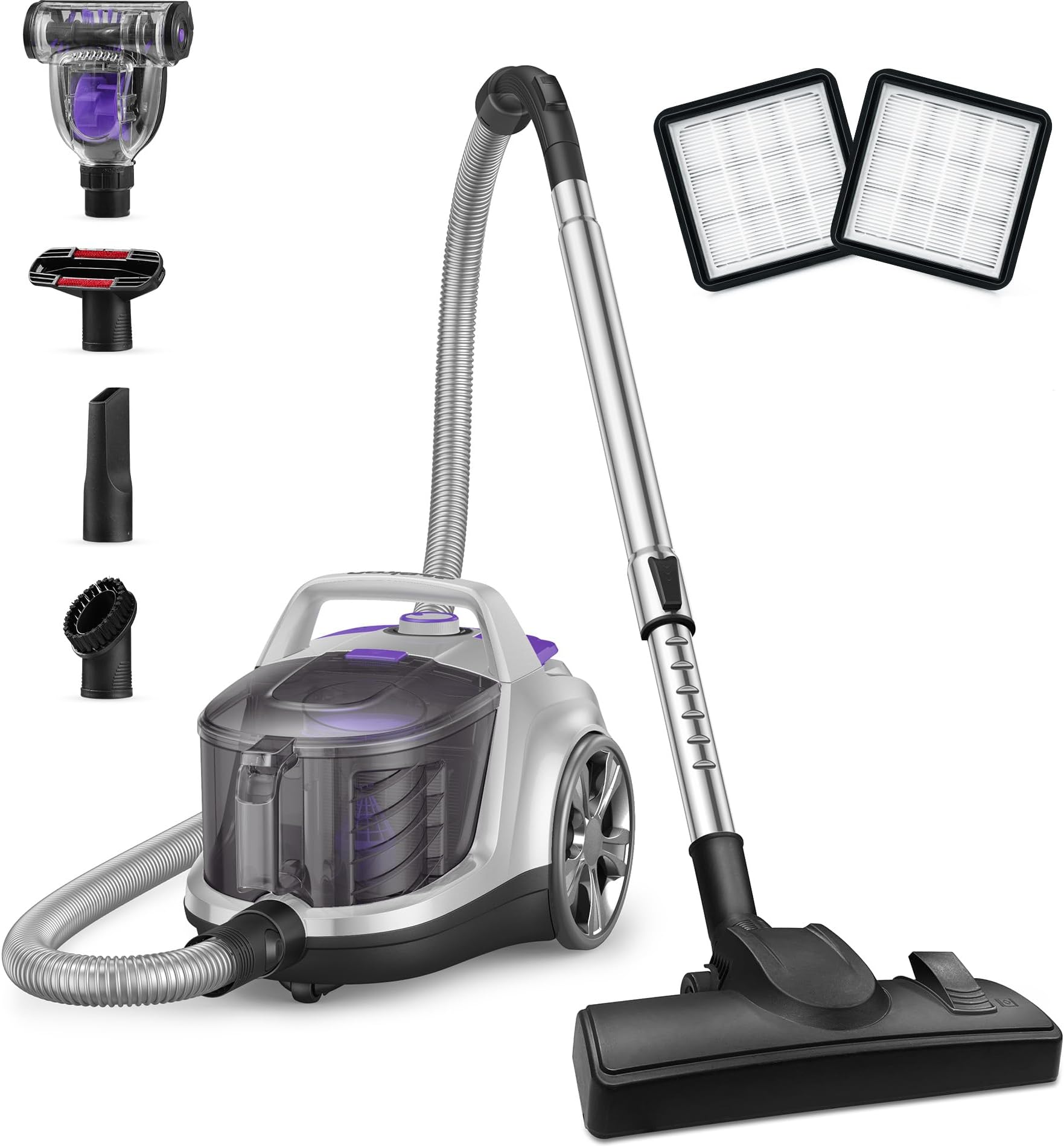
Canister vacuum cleaners feature a main body that sits on the floor and connects to a long hose and suction wand. Most models use high-power motors with a direct power supply and incorporate technologies such as multi-stage filtration, Cyclone systems, and adjustable suction control.
Advantages
- Stable and strong suction performance
- Suitable for large homes and multiple rooms
- Effective on hard floors, carpets, and narrow gaps
- Wide range of compatible attachments
Limitations
- Bulky size and storage requirements
- Limited mobility due to power cords
- Less convenient for multi-story homes
2. Upright Vacuum Cleaners

Key Characteristics and Technologies
Upright vacuum cleaners have a vertically integrated design where the motor and suction head are combined into a single unit. Many models focus on carpet cleaning efficiency and include motorized brush rolls and height adjustment mechanisms.
Advantages
- Effective carpet cleaning performance
- Easy operation on large, open floor areas
- Minimal bending during use
Limitations
- Limited flexibility in tight or low-clearance spaces
- Relatively heavy and bulky
- Less common in some regions
3. Handheld Vacuum Cleaners

Key Characteristics and Technologies
Handheld vacuum cleaners are compact and lightweight devices, usually powered by rechargeable batteries. They often use small DC motors and simplified Cyclone filtration systems.
Advantages
- Easy to handle with one hand
- Convenient for spot cleaning and vehicles
- Cordless and easy to store
Limitations
- Limited suction power
- Small dust container capacity
- Short operating time
4. Classification by Filtration Technology
4.1 Bagged Vacuum Cleaners
Key Characteristics and Technologies
Bagged vacuum cleaners collect dust and debris inside disposable or reusable bags, which also function as a primary filtration layer. Some models combine dust bags with additional HEPA filters.
Advantages
- Reduced dust exposure during disposal
- Simple maintenance process
- Suitable for users sensitive to dust
Limitations
- Ongoing cost for replacement bags
- Suction performance may decrease as the bag fills
4.2 Bagless Vacuum Cleaners (Cyclone Technology)
Key Characteristics and Technologies
Bagless vacuum cleaners use Cyclone technology to separate dust from airflow using centrifugal force. Dust is collected in a transparent container, while air passes through secondary filters.
Advantages
- No need for replacement dust bags
- Easy monitoring of dust accumulation
- More consistent suction performance
Limitations
- Potential dust release during emptying
- Requires regular cleaning of filters
4.3 Water Filtration Vacuum Cleaners
Key Characteristics and Technologies
Water filtration vacuum cleaners pass air and debris through a water chamber, trapping dust particles in water instead of dry containers or bags.
Advantages
- Effective dust and allergen retention
- Reduced airborne dust during operation
Limitations
- Complex structure and maintenance
- Requires water replacement and cleaning after use
- Limited product availability
4.4 Vacuum Cleaners with HEPA Filtration
Key Characteristics and Technologies
HEPA filters are designed to capture very fine particles, including dust, pollen, and pet dander. HEPA filtration is typically combined with bagged or Cyclone-based systems.
Advantages
- Improved capture of fine particles
- Cleaner exhaust air output
- Suitable for households with allergies
Limitations
- Filters require periodic replacement or cleaning
- Filtration efficiency depends on overall system design