
Airflow Path, Pressure Loss & Why “High Suction” Numbers Mislead Users
Understanding Real Cleaning Performance Beyond Marketing Metrics
1. Suction Power Is Only a Potential, Not Performance
Manufacturers often promote vacuum cleaners using terms such as high suction, maximum air watts, or strong pressure ratings.
These numbers describe potential energy at the motor, not actual cleaning performance at the floor. Cleaning happens at the cleaning head, not at the motor inlet.
Between these two points lies the entire airflow path, where most performance is lost.
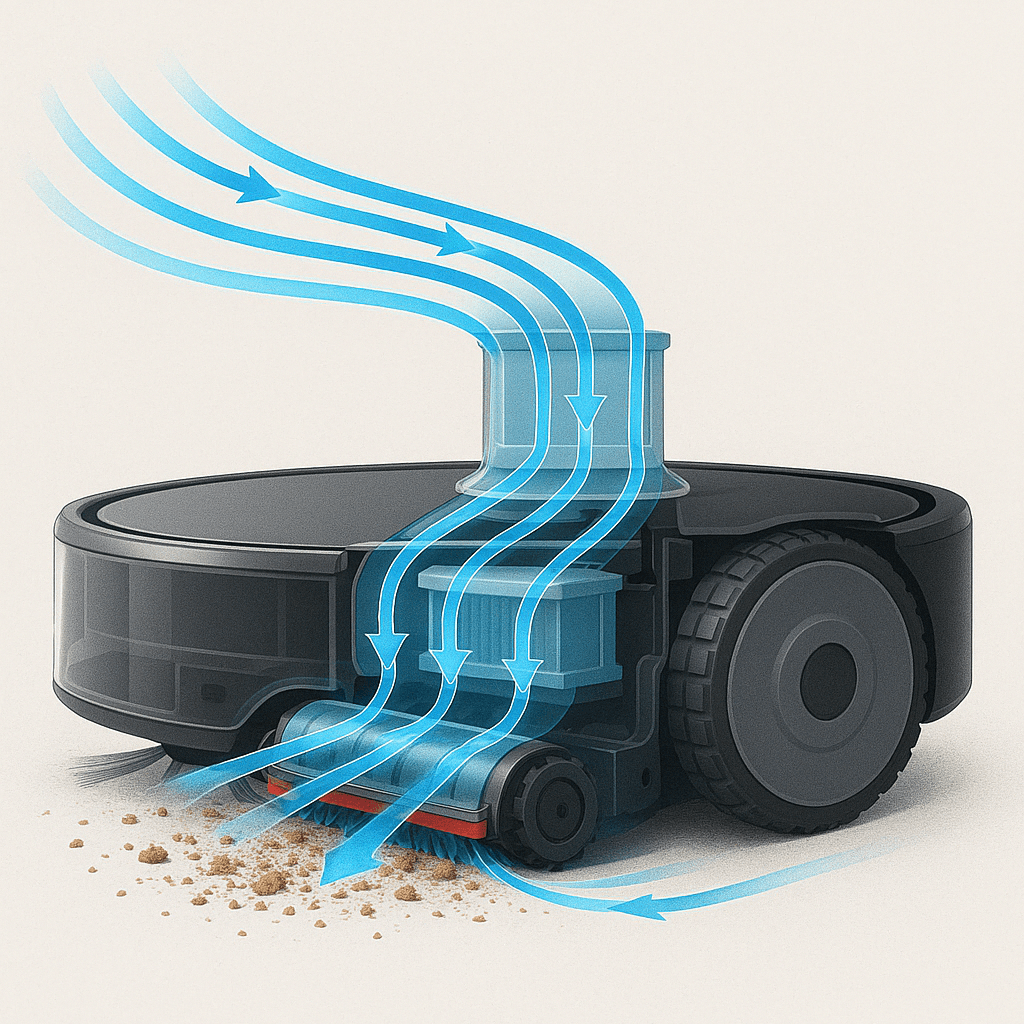
2. What Airflow Path Actually Means
The airflow path is the complete route that air travels through the vacuum system:
- Cleaning head inlet
- Floor seals and brush chamber
- Wand or hose
- Cyclone or dust bag
- Pre-filters
- Fine filters or HEPA filters
- Motor chamber
- Exhaust filter
- Exhaust outlet
Every bend, restriction, and surface along this path reduces usable airflow.
3. Airflow vs Suction: Two Different Concepts
Suction (Static Pressure)
- Measured as pressure difference
- Indicates pulling force under restricted airflow
- Often measured with airflow partially blocked
Airflow (Volume)
- Measured as air volume per unit time
- Determines how much debris can be transported
- Critical for real cleaning performance
Effective cleaning requires both, but airflow at the surface is usually more important than peak suction.
4. Why High Suction Numbers Are Misleading
Suction values are often measured at the motor inlet under ideal laboratory conditions.
In real-world use, airflow is reduced by:
- Air leakage at the cleaning head
- Filter resistance
- Hose bends and length
- Dust accumulation
A vacuum with lower rated suction but higher airflow efficiency can outperform a high-suction model.
5. Pressure Loss: The Invisible Performance Killer
5.1 What Pressure Loss Is
Pressure loss is the reduction of usable energy caused by friction, turbulence, directional changes, and air leakage along the airflow path.
5.2 Common Sources of Pressure Loss
Cleaning Head
- Poor sealing
- Excessive air gaps
- Narrow airflow channels
Hose and Wand
- Long hose length
- Sharp bends
- Ribbed internal surfaces
Cyclone Systems
- Aggressive cyclone geometry
- Multiple airflow direction changes
- Fine dust buildup
Filters
- Small surface area
- Fine pore structures
- Partial clogging
6. Turbulence vs Laminar Flow
Airflow inside vacuum cleaners is rarely smooth.
- Laminar flow minimizes energy loss
- Turbulent flow increases pressure loss
Well-designed systems reduce unnecessary turbulence through smooth transitions and controlled airflow paths.
7. Why Shorter, Straighter Paths Matter
Vacuum designs with short airflow paths, gentle curves, and smooth internal surfaces maintain higher airflow at the cleaning head.
Compact stick vacuums often perform better than larger units due to reduced pressure loss, not stronger motors.
8. The Role of Sealing in Airflow Efficiency
Air always follows the path of least resistance.
If air enters through gaps in the cleaning head, dust bin, or hose connections, it bypasses debris and reduces cleaning effectiveness.
Sealed systems preserve airflow where it matters most.
9. Airflow at the Cleaning Head Is What Cleans
Real cleaning performance depends on:
- Air velocity at the floor
- Controlled airflow direction
- Mechanical agitation from brushes
High airflow at the motor is meaningless if it does not reach the debris.
10. Carpet vs Hard Floor Airflow Requirements
Hard Floors
- Wide airflow distribution
- Lower resistance
- High dependence on sealing
Carpets
- High air velocity
- Deep airflow penetration
- Strong brush agitation
A single airflow setup cannot be optimal for both surfaces without compromise.
11. Why “No Loss of Suction” Claims Fail
These claims usually mean motor suction remains high, not that airflow at the cleaning head stays constant.
In real use:
- Filters clog
- Cyclone efficiency declines
- Seals degrade over time
Performance loss is unavoidable; good design only slows it.
12. Real-World Comparison Example
A vacuum with extremely high rated suction but poor airflow design may underperform compared to a model with moderate suction, smooth airflow paths, better sealing, and larger filters.
13. Why Marketing Focuses on Suction Numbers
Suction values are easy to measure, easy to compare, and easy to advertise.
Airflow efficiency, pressure loss, and sealing quality are harder to quantify and are often ignored in marketing.
14. What Experts Evaluate Instead
- Airflow path length and geometry
- Cleaning head sealing quality
- Filter surface area
- Maintenance behavior over time
15. Core Principle
A vacuum cleaner is not a motor with a hose attached.
It is an airflow system, and cleaning performance depends on how efficiently that system delivers airflow and agitation to the surface where dirt actually exists.